It's 7:12 on a Tuesday. You just closed your laptop, the sink already has yesterday's dishes in it, and someone in the house is asking what's for dinner. If your honest answer is "I don't know yet," this article is for you.
I've been cooking easy one pan dinner recipes for busy nights for years, not because I love minimalism but because I genuinely hate loading a dishwasher at 9 p.m. What I've learned is that "one pan" means almost nothing on its own. Most recipes labeled that way still leave you with a bowl, a whisk, and a cutting board to scrub. So let's talk about what actually works when your energy is gone and the clock is against you.
Key Takeaways
- True one-pan meals keep the active prep under 15 minutes and the cleanup to a single vessel plus a knife.
- Sheet pan dinners, skillet meals, and one-pot pastas each solve a different problem: oven space, stovetop speed, and leftovers.
- If you're cooking for kids, mild seasoning and a separate sauce on the side beats trying to please everyone in the pan.
- A $12 bag of groceries can cover three dinners if you stop buying pre-cut vegetables.
- No-oven nights are entirely possible with one wide pan and a lid.
- Batch cooking the base of a meal—rice, roasted vegetables, a pot of beans—cuts weekday cooking time roughly in half.
What makes a one-pan dinner actually work
Cooking times, not ingredient lists, are what break most one-pan recipes. You can throw chicken thighs, potatoes, and broccoli on the same tray, but if you put them all in at once the broccoli turns to mush before the potatoes soften. That's the trap.
The fix is embarrassingly simple. Cut things smaller, stagger when they go in, or pick ingredients that finish at roughly the same time. I learned this the hard way after a sheet pan of salmon and sweet potato that came out as one soggy, one raw.
The three real constraints
Every weeknight dinner runs into the same walls. First, active time—how long you're standing at the counter. Second, passive time—how long the oven or stove does the work while you answer emails. Third, cleanup surface area.
A recipe that takes 10 minutes of chopping and 35 minutes in the oven is a win. A recipe that takes 40 minutes of constant stirring is not, no matter how few pans it claims.
So here's my rule: if a "one-pan" recipe needs more than one bowl or one knife, I'm skeptical. That's it. That's the whole test.
Pan size matters more than you think
Crowding is the silent killer. Vegetables piled on top of each other don't roast—they steam. A half sheet pan (roughly 18 by 13 inches) handles dinner for four. A small rimmed pan handles two, at best. If you own one big skillet, use it for everything on this list and see how far you get.
Easy one pan dinner recipes for busy nights: healthy versions
Healthy here means vegetables that still taste like something, plus a protein that isn't drowning in sauce. Two of my regulars:
Sheet pan chicken with root vegetables
Chop carrots, parsnips, and red onion into pieces no bigger than a thumb. Toss with oil, salt, and paprika directly on the pan. Nestle in bone-in chicken thighs and roast everything together. The vegetables go in ten minutes early; the chicken finishes on top. Total active time: about 12 minutes.
No bowl. I mix it with my hands on the pan itself. Sounds gross, works fine.
One-pot lentil and spinach skillet
This is my fallback when there's no meat thawed. Sauté an onion, add dried lentils and stock, cover, and let it simmer until tender. Stir in spinach at the end. It costs very little per serving and holds in the fridge for four days—which matters more than you'd think on a Thursday.
The trick with lentils: don't stir. Every stir adds time. Leave them alone, lid on, low heat.
Easy one pan dinners for family (kid-friendly)
Kids will reject a whole dinner over one visible green fleck. Fighting that is a losing battle, so I stopped trying.
Build it in the pan, not on the plate
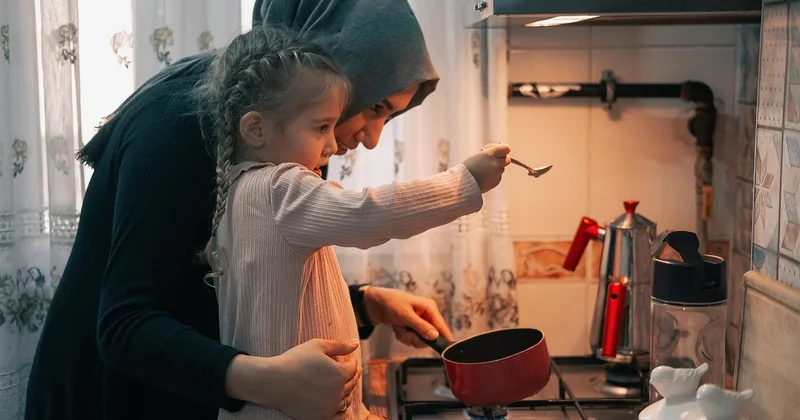
Cook a plain base—rice, pasta, or potatoes—then add the "grown-up" parts after you've served the younger eaters. A plain baked chicken thigh moves through a kid's dinner with zero complaints; the spicy yogurt sauce stays in a small dish on the side.
My rule for family meals: season the base lightly, finish the adult portions individually. One pan, no separate kids' menu, no tantrum at the table.
A note on picky eaters
If your child eats three foods and refuses everything else, a one-pan stir fry isn't the place to experiment. Stick to familiar textures. A pan of noodles, butter, and parmesan beats a beautifully balanced tray of roasted beets nobody touches.
Easy one pan dinners for family on a budget
Budget cooking and one-pan cooking overlap more than people realize, because both depend on cheap base ingredients.
Dried beans, rice, pasta, potatoes, and eggs get you very far. Add one affordable protein and a vegetable that's in season, and dinner is done for under $3 a plate. Pre-cut vegetables can cost two to three times what whole ones do, so buying whole and chopping yourself is the single biggest savings lever here.
The cheapest pan dinner I make
Rice cooked in the same skillet as canned tomatoes and a handful of frozen peas. Add an egg on top near the end. It's not glamorous. It costs almost nothing and it's on the table in under 25 minutes. I make it at least once a week.
One-pan meals with no oven required
Summer, small apartment, broken oven—whatever the reason, you can skip the oven entirely.
Skillet-only dinners
A wide pan with a lid is the entire toolkit. Sauté aromatics, add liquid and a starch, cover, and let steam finish the job. Pasta cooked directly in a shallow pan of sauce is the classic version, and it comes together in the time it takes pasta to boil anyway.
Stir-fry is the other workhorse. High heat, quick-cooking vegetables, protein cut small. Everything in one pan, five to seven minutes of actual cooking.
What doesn't work on a stovetop
Bone-in chicken and thick potato wedges need oven time to cook through without burning outside. If you only have a burner, cut everything small. It changes the dish, but it works.
| Method | Best for | Active time | Cleanup |
|---|---|---|---|
| Sheet pan | Feeding four, hands-off cooking | 10–15 min | Pan + foil |
| Deep skillet with lid | Pasta, rice, lentils | 10 min | Pan + spoon |
| Wide sauté pan | Stir-fries, quick proteins | 7–12 min | Pan only |
| Dutch oven | Chili, stews, big batches | 15 min | One heavy pot |
One pan oven dinner ideas worth repeating
Roasting is the least demanding cooking method there is. You assemble, you walk away, you come back when a timer goes off. That's it.
The formula, not the recipe
Pick a protein, pick two vegetables that cook at similar speeds, season everything the same way, roast at around 220°C (425°F). Salmon and asparagus. Sausages and peppers. Chicken thighs and broccoli. Tofu and green beans.
The formula matters more than any single recipe, because it lets you cook with what's actually in the fridge instead of running to the store. I've made this work with almost nothing in the house and a bag of frozen mixed vegetables. It's fine. Frozen vegetables roast perfectly well—just spread them out and don't crowd the pan.
Keep leftovers from getting boring
Cook once, eat twice, but change the format. Last night's roasted chicken becomes today's tacos or a quick fried rice in the same pan. Same ingredients, different meal.
Store everything in the pan if it has a lid, or transfer to one container. Fewer containers, less to wash, and you're far more likely to actually eat what you cooked.
A few things I got wrong
I once tried to cook a full one-pan lasagna in a skillet. It took over an hour and the bottom scorched. Not everything belongs in one pan, and pretending otherwise just wastes an evening.
I also spent months buying pre-chopped onions to save time, which roughly doubled my grocery bill for no real gain. Chopping an onion takes ninety seconds. It's not the bottleneck.
The bottleneck is deciding what to cook.
Which is why the real skill here isn't any single recipe. It's building a short list of dishes you can make without thinking, from whatever happens to be in the kitchen at 7 p.m. on a Tuesday. Five or six of those, memorized, will get you through more busy nights than any collection of fifty recipes you have to look up.