A cook I know bought a 14-piece knife block for her first apartment. Two years later, she still grabs the same dull 8-inch chef's knife for everything—and she's not alone. Walk into any home kitchen and you'll find one hero blade, a couple of mystery knives nobody touches, and a cutting board that's seen some things. The gap between that kitchen and a restaurant line isn't talent. It's a handful of specific habits, practiced until they stop feeling like technique and start feeling like breathing.
That's what this guide is about: the knife skills every home cook should master—not forty of them, not a culinary-school syllabus, but the core moves that actually change how you cook. I've spent years watching home cooks struggle with the wrong grip, the wrong blade, and the wrong order of operations, and I can tell you the fix is usually smaller than people expect.
Key Takeaways
- The pinch grip is the single highest-leverage change you can make—it improves control, speed, and safety at once
- You need exactly three knives, not a set. A chef's knife, a paring knife, and a serrated bread knife cover 95% of home cooking
- Sharpness is safety. A dull blade needs force, and force is what sends knives into fingers
- Learn five cuts—slice, dice, chop, mince, julienne—and you can improvise the rest
- Practicing on onions, carrots, and potatoes costs almost nothing and improves faster than any gadget
- A sharpening routine beats any single expensive knife purchase
Why knife skills matter more than you think
Here's the thing nobody tells you when you buy your first "good" knife: the blade is not the skill. It's a multiplier.
A sharp knife in clumsy hands still gives you uneven chunks. A mediocre knife in practiced hands gives you brunoise. The variable that moves is you, not your equipment, and that distinction is worth ten minutes of your attention before you spend another dollar on gear.
The real cost of slow, uneven chopping
Uneven pieces cook unevenly. That's not a culinary-school nicety—it's the reason your sautéed onions end up burnt at the edges and raw in the middle. When one piece is 3mm and the next is 12mm, no pan on earth can compensate. You'll stir more, you'll crowd the pan, you'll steam instead of sear, and dinner takes twenty extra minutes for a worse result.
I've watched home cooks blame their stove, their pans, their "cheap" ingredients. Nine times out of ten the pan is fine. The cuts aren't.
What improvement actually looks like
When I started paying attention to my grip instead of my knife, my prep time for a standard mirepoix (onion, carrot, celery) dropped noticeably—not because I was rushing, but because I stopped fighting the blade. Fewer corrections, fewer rescues, fewer times reaching for the knife again to fix a piece that didn't come out right. That's the whole game: reduce the corrections.
What are the 5 basic knife skills?
If you only ever learn five things, learn these. They're the foundation everything else sits on, and each one compounds the others.
- The pinch grip—thumb and index finger pinching the blade where it meets the handle, remaining fingers wrapped around. This is the grip that gives you control.
- The claw—your guiding hand curls its fingertips under, knuckles forward, so the blade rides against your knuckles instead of your fingertips. It feels awkward for a week and then it feels like armor.
- Basic slicing—a forward-and-down motion, not a straight chop. The blade should travel, not just descend.
- Dicing, which is really just slicing in three directions
- Mincing—rocking the blade through garlic, herbs, or ginger until the pieces stop being distinguishable
Notice what's not on that list: speed. Speed is a byproduct. Chase accuracy, and speed shows up on its own, usually within a few weeks of consistent practice.
Why the pinch grip changes everything
Most home cooks hold a chef's knife like a hammer—hand wrapped around the handle, blade far from the hand. It feels natural because it's how you'd hold a tool with no edge. But it puts your wrist in charge of the blade's angle, and your wrist is a poor steering wheel. The pinch grip puts your fingers directly on the blade, which means the blade goes exactly where you point it. Same knife, completely different tool.
What knives should every home chef have?
Three. That's the honest answer, and it will annoy anyone who just bought a 12-piece set.
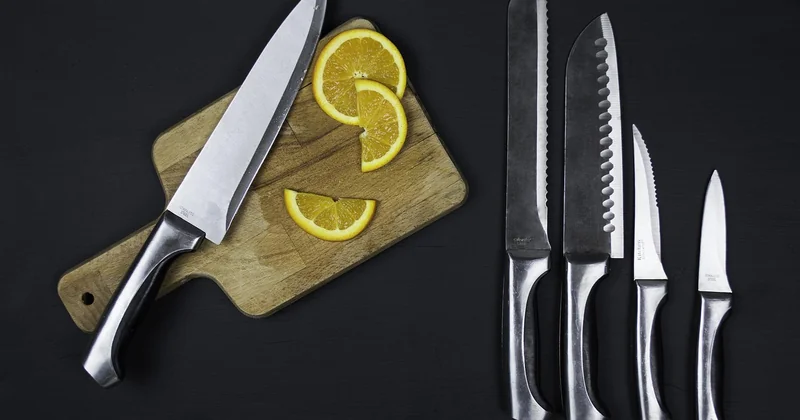
| Knife | Typical blade length | What it's for | Do you actually need it? |
|---|---|---|---|
| Chef's knife | 6–10 inches | 90% of all cutting: onions, proteins, vegetables, herbs | Yes—this is the one |
| Paring knife | 3–4 inches | Small, precise work: peeling, trimming, hulling strawberries | Yes |
| Serrated bread knife | 8–10 inches | Bread, tomatoes, anything with a tough exterior and soft interior | Yes, and it earns its spot |
| Santoku | 5–7 inches | Similar role to a chef's knife, flatter profile | Only if it suits your hand better |
| Boning knife | 5–6 inches | Breaking down poultry, filleting | Nice to have, not essential |
Match the blade to your hand, not to a number
The standard advice says "buy an 8-inch chef's knife." That advice assumes a standard hand. If your hands are small, a 6-inch blade will give you far more control; if they're large, an 8- or 10-inch blade balances better and lets you cut with less wrist strain. The right length is the one where the tip doesn't feel like it's operating in a different time zone.
Skip the block set. Those knives are usually stamped, thin, and designed to fill slots on a countertop rather than to cut well. One good chef's knife you actually enjoy holding beats twelve you avoid.
Sharpening matters more than buying
A $30 knife sharpened every few weeks outperforms a $200 knife that hasn't seen a stone in two years. This isn't close. Get a honing rod for weekly touch-ups and either a whetstone or a decent pull-through sharpener for the real work. Learn one method, whatever it is, and use it. The knife that cuts cleanly is the knife that keeps your fingers safe, because it doesn't require the shove that turns a slip into a cut.
What are the 10 most important knife skills?
Five is the floor. Ten is where you start cooking like someone who's been doing this a while. Here's the fuller list, ordered roughly by how often you'll use each one.
- The pinch grip—covered above, and it never stops mattering
- The claw hand—the safety habit that lets you cut fast without fear
- Slicing—consistent thickness in one direction
- Dicing—slicing, rotating ninety degrees, slicing again, then cross-cutting into cubes
- Julienne—matchsticks, roughly 3mm square and a few centimeters long
- Brunoise—julienne cut crosswise into tiny cubes, the finest of the classic cuts
- Chiffonade—stacking leafy herbs or greens, rolling them tight, and slicing into ribbons
- Mincing—rocking through garlic, ginger, or herbs to a near-paste consistency
- Rock chopping—keeping the tip on the board and rocking the blade through herbs or nuts
- Guiding the blade with both hands—the coordination that ties every cut together into one flow
The catch? You don't need to master all ten before cooking a single meal. Learn one, use it for a week, then add the next. Stacking them one at a time is how they stick.
The cuts most home cooks skip (and shouldn't)
Chiffonade is the one I see skipped most. People tear basil with their fingers or dump whole leaves into a pan, and the result is bruising and uneven flavor. Stacking, rolling, and slicing takes fifteen seconds and gives you ribbons that distribute evenly through a dish. Same for mincing—whole garlic cloves thrown into oil burn on the outside while staying raw inside. Thirty seconds with a rocking motion fixes it.
How to practice knife skills without wasting food
You don't need to sacrifice a bag of onions every evening. Start with the cheapest, most forgiving ingredients, and cook what you practice.
- Carrots—cheap, firm, and perfect for julienne and brunoise drills
- Potatoes—large enough to practice even cuts without pressure
- Onions—the ultimate dice practice, and every version of them ends up in a real dish
- Herbs—parsley and cilantro are forgiving, and minced herbs go into almost anything
- Zucchini or cucumber—soft enough to reveal whether your blade is actually sharp
- Apples—good for peeling and quartering practice, and you eat the evidence
Roast the results. Soup them. Toss them into a stir-fry. Nothing you practice needs to end up in the bin, and cooking what you cut is the fastest feedback loop there is: you'll taste the difference even cuts make, which keeps you coming back to the board.
A five-minute drill that actually works
Set a timer for five minutes. Cut one onion, aiming for pieces as close to identical as your hands allow. Don't rush. When the timer ends, look at the pile. If you can spot the outliers immediately, that's your benchmark—do it again tomorrow and compare. Within two weeks, the pile starts looking uniform without you thinking about it. This beats any gadget, app, or class, because it's specific, measurable, and free.
What are some important knife skills worth mastering for cooking specifically?
Cooking rewards a few skills that pure technique lists tend to bury. Order of operations matters as much as the cutting itself: prep everything before the pan gets hot, group ingredients by when they hit the heat, and cut in the sequence that keeps your board clean. This is what separates a smooth cook from a frantic one.
Consistency beats precision. Nobody at your dinner table will measure your brunoise. They will notice that everything cooked at the same rate, that the garlic didn't burn, that the herbs tasted fresh instead of bruised. That's the payoff, and it comes from cuts that are even, not cuts that are textbook-perfect.
The habit nobody mentions
Clean as you go, and keep your board dry. A wet board lets ingredients slide, and sliding ingredients are how knives wander. A quick wipe between batches takes seconds and keeps your claw hand honest. It's the least glamorous skill on this list and one of the most useful.
How long until it feels natural?
The grip feels wrong for about a week. The claw feels wrong for two. After a month of regular cooking, both feel so obvious that you'll wonder how you ever held a knife another way. There's no shortcut around that awkward phase—but it's short, and it only happens once.
Every meal is practice. The onion you're dicing tonight is tomorrow's muscle memory. Put your hand on the blade, curl your fingers, and cut something—the skill was never in the knife. It's in the repetition, and it starts the moment you stop reading about it.