Four drawers. That's what I had to work with in my last apartment kitchen, along with a 40 cm stretch of counter between the sink and the stove. For the first month, I did what everyone does: I bought a stack of plastic organizers, shoved everything in, and told myself it was fine. It wasn't fine. By week six, the drawer with the utensils had become a graveyard of things I never touched, and I couldn't close the cabinet under the sink without a fight.
So I started over. Not with a shopping spree, but with a question I couldn't find answered anywhere: which small kitchen organization ideas actually hold up over time? Not "looks nice in a photo" — works. Six months later, most of what I'd bought was in a donation box. The handful of things that survived changed how the whole room functioned.
This is what I learned, including the parts that failed.
Key Takeaways
- The single highest-impact move in a small kitchen is going vertical on the walls, not buying more containers.
- Before you buy anything, measure the swing arc of every door — oven, fridge, cabinet. Half of my early purchases blocked something.
- Renting changes the rules: tension rods, adhesive strips and over-door racks do 80% of what drilling does.
- Clear containers only help if you commit to a labeling habit. Otherwise they just show you the mess more clearly.
- I wasted roughly €140 on organizers that didn't survive six months. The fixes that lasted cost me under €60 total.
Why most small kitchen organization ideas fail
Here's the thing nobody tells you: most storage advice is written for kitchens with room to spare. Those pretty baskets and tiered shelves assume you have a wall, a corner, or a cabinet door free. In a genuinely tight kitchen — an L-shape under 5 m², a galley with one run of counter — you don't. You have conflicting demands fighting for the same cubic centimeters.
The result is that people solve the wrong problem. They buy containers to organize clutter, when the real issue is that the clutter has nowhere to live. Adding bins to a crowded drawer doesn't create space. It just redistributes the same problem into tidier-looking piles.
The real problem is volume, not order
I tracked this obsessively for two months. Every item that entered my kitchen got logged: how often I used it, where it lived, whether it blocked anything else. The pattern was brutal. Roughly a third of what I owned I used less than once a month — a waffle iron, a second colander, three mismatched baking dishes. None of it was clutter in the sense of being junk. It was clutter in the sense of being present without being useful.
No organizer fixes that. Only removing things does.
Once I cleared that third out, the remaining two-thirds suddenly fit into the drawers and cabinets I already had. I didn't need a single new product for the first round. That's the part that stings when you've just spent money on solutions.
Measure the swing arc before you buy anything
My most expensive mistake was a slim rolling cart that I was certain would slot perfectly beside the fridge. It did slot perfectly. Then I opened the fridge door, and the cart's top shelf jammed against the handle. Every single time. I kept it for two weeks hoping I'd get used to the workaround, then gave up.
Before any purchase, open every door in the kitchen and note where it lands. Cabinet doors, oven door, dishwasher if you have one. That open space is not storage. It's circulation, and it's the constraint most listicles never mention.
The moves that actually worked
Three changes survived the six-month test. None of them were clever. All of them were boring, cheap, and adapted to the specific walls I had.
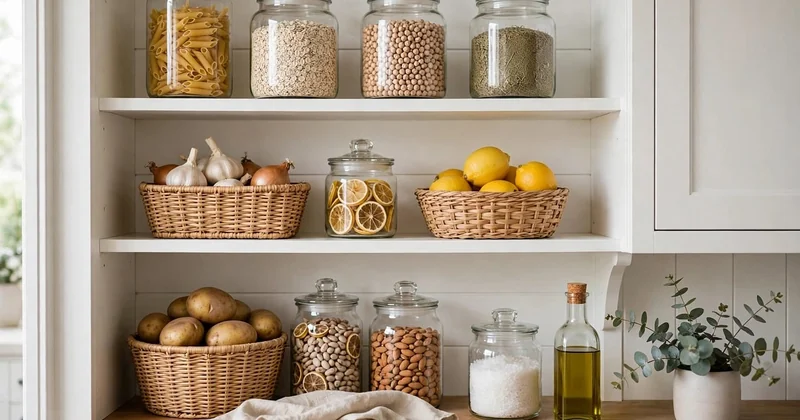
Go vertical on the walls — this is the big one
I mounted a single rail above the counter and hung the utensils I used daily. That one move freed an entire drawer. Then I added a second rail on the side of a cabinet where no door swung, and hung measuring cups and a small pan. Total cost: under €25. Total space recovered: the equivalent of roughly two drawers.
Why it works: your counter and drawers are horizontal surfaces, and horizontal surfaces are scarce. Your walls are vertical, and above 50 cm from the counter they're almost entirely unused. You're not adding storage. You're using storage that was always there.
Tension rods are the renter's answer
I rent. Drilling into tile was off the table, and honestly I didn't want the hassle. Tension rods handle most of what mounting hardware does. One under the sink holds cleaning spray bottles off the floor. One inside a deep cabinet creates a second tier for stacked items. Two across a narrow window ledge hold nothing heavier than a cutting board, but that cutting board needed a home.
The catch: tension rods fail under weight and heat. I learned this after a rod slipped and dropped a bottle onto my foot. Keep them light. Never trust them with glass or anything over about a kilogram.
Over-door racks for appliances
My kitchen had no cabinet tall enough for a stand mixer. The over-door rack I hung on the pantry door solved it, along with space for two baking sheets that had been propped against the wall collecting dust. It's ugly. It's also the reason I can actually bake now.
This is where small kitchen storage ideas without cabinets stop being theoretical. When you have no cabinetry to work with, you borrow the doors, the walls, and the dead space above appliances. All three are usually available in kitchens people describe as "too small to organize."
What I tried and abandoned
Honesty matters more than a clean list here. Half of what I bought early on didn't work, and the reasons are worth knowing.
- Stackable clear bins — looked organized for two weeks, then became a nesting ground for things I couldn't see and stopped using.
- An under-shelf basket for the pantry — it sagged under cans and blocked the shelf below.
- Magnetic spice tins on the fridge — a good idea that turned into a weekly re-stacking chore because they slid.
- A drawer divider set sized for a bigger drawer — I trimmed it, it cracked, and I kept it for pride reasons for a month.
- Labeling every container — committed to it for five weeks, then let it slide, and then the labels were worse than no labels because they were wrong.
Notice the pattern? Almost every failure was a product that assumed a shape of kitchen I didn't have. The wins were adaptations, not purchases.
| Approach | Cost | Lasted 6 months? | Why |
|---|---|---|---|
| Wall rail system | ~€25 | Yes | Used dead vertical space, nothing to break |
| Tension rods | ~€12 | Yes | No drilling, works in rentals |
| Over-door rack | ~€20 | Yes | Borrowed a door that was doing nothing |
| Stackable clear bins | ~€45 | No | Hid items without creating space |
| Magnetic spice tins | ~€30 | No | Slid and needed constant resetting |
| Pre-sized drawer dividers | ~€35 | No | Wrong dimensions for a small drawer |
The budget arbitrage: spend on access, not containers
If you take one financial rule from all of this, make it this: spend your money on access, not on containment. Containers hold things. Access is what lets you reach the things you already own. In a small kitchen, access is the scarce resource.
€20 spent on a wall rail beats €60 spent on a matching container system every time. The rail changes how many items you can touch without moving anything else. The containers change nothing except how the problem looks.
And here's the uncomfortable corollary: the biggest gains came from removing things, which cost nothing. Sorting, donating, and letting go of the waffle iron recovered more usable space than the entire €140 of organizers I discarded.
Questions I get asked most
Do clear containers actually help in a small kitchen?
Only if you can see through to the labels and keep them accurate. In practice, clear containers help most in the pantry where you need to spot what's running low. In drawers, they mostly show you mess you already knew was there. Start with one shelf, not the whole kitchen.
What if I can't drill into anything?
Tension rods, over-door racks and adhesive hooks cover the vast majority of the wins. The wall rail is the one thing that really wants a screw, but a tension rod across a window frame or a freestanding narrow shelf beside the counter gets you close. Skip anything that needs a heavy anchor if your walls won't take one.
How often should I reorganize?
Once a season, and no more than that. Constant reorganizing is usually a sign you own too much, not that your system is wrong. If you find yourself rearranging the same drawer every month, empty it out instead.
The kitchen in that apartment is gone now, and I've moved. But the rail is still the first thing I install in any new place, before the boxes are even unpacked. It costs a fraction of what I wasted on bins, it takes an afternoon, and it fixes the one thing no product ever will: the fact that your walls have been empty this whole time.