The question usually lands mid-conversation, somewhere between "what should I buy?" and "why does everything stick?" A friend is standing in a kitchenware aisle, holding a $29 nonstick skillet in one hand and a $30 lodge skillet in the other, and asking me which one they should walk out with. My answer has been the same for years: both. But if you're only buying one, the answer depends on which failure mode you can live with.
Here's the thing most comparison articles won't tell you: cast iron and nonstick solve different problems. Cast iron holds heat and transfers it evenly across a heavy surface, which is why it sears a steak properly. Nonstick releases food from its surface with almost no fat, which is why it cooks an egg without drama. Swap them and you get a bad steak and a wrecked egg pan. The real question isn't which is "better." It's which one you'll actually reach for on a Tuesday night at 7:15pm when you're tired and hungry.
Key Takeaways
- Heat retention isn't the same as heat response. Cast iron takes minutes to warm up, then stays hot. Nonstick heats fast but falls flat the moment cold food hits it.
- The PTFE coating on nonstick pans starts breaking down above roughly 260 °C (500 °F), which is easy to hit when you preheat an empty pan on high.
- A $30 nonstick pan usually lasts one to three years with regular use. A $30 cast iron skillet can outlive you.
- Cast iron leaches iron into food, especially acidic dishes like tomato sauce. That's a feature for most people and a problem for a few.
- Induction compatibility is where nonstick quietly loses. Many coated pans aren't induction-ready; cast iron always is.
- The honest answer is a two-pan kitchen: one cast iron for searing and oven work, one nonstick for eggs and delicate fish.
Why the cast iron vs nonstick debate never actually ends
Because both sides are right, and both sides are describing a different meal.
I cooked on nothing but nonstick for the first four years I lived on my own. My eggs were perfect. My stir-fries were gray and sad because I couldn't get the pan hot enough without the coating smoking and flaking. Then I bought a cast iron skillet, ruined two batches of fried rice by sticking them to the bottom (I hadn't seasoned it properly), and nearly gave up on the whole thing. The turning point was realizing cast iron isn't a nonstick substitute. It's a different tool that does things nonstick can't, and does other things worse.
What each pan actually does well
Cast iron's superpower is thermal mass. A thick slab of iron stores heat and releases it slowly, so when you drop a cold steak on it, the surface temperature barely dips. That's what gives you a proper crust. Nonstick's superpower is low surface friction, which means almost nothing sticks and you can cook with a teaspoon of oil instead of a tablespoon.
The trade-off is that these properties work against each other. A surface that releases food easily can't develop a brown crust as effectively, because browning requires the food to stay in contact with a hot surface long enough to caramelize. And a surface that holds heat aggressively doesn't care about your schedule. If you're in a hurry, cast iron punishes you.
The health question nobody answers straight
Look, I'm not a chemist and I won't pretend to be one. But the honest version of the health comparison is more interesting than "nonstick is toxic" or "cast iron gives you iron."
Is non stick cast iron safe?
Non stick and cast iron are two different materials, so the question doesn't quite hold together, but the underlying concern is real. Modern nonstick pans are coated with PTFE, the material commonly called Teflon. Intact and used at normal cooking temperatures, PTFE is considered safe by regulators. The risk appears when the coating is overheated — above roughly 260 °C (500 °F), the coating starts to degrade, and at higher temperatures it releases fumes that can cause flu-like symptoms in humans and are genuinely dangerous for pet birds. You hit those temperatures most easily by preheating an empty pan on high heat, which is exactly what people do before searing.
Cast iron has a different profile. It's inert — no synthetic coating to degrade. But it does release iron into food, and the amount depends on three things: how acidic the dish is, how long you cook it, and how well-seasoned the pan is. A well-seasoned pan releases less. A tomato sauce simmered for 45 minutes in a lightly seasoned pan releases more. For most people, that extra iron is harmless or mildly beneficial. For people with hemochromatosis, a condition where the body absorbs too much iron, it's a genuine reason to cook acidic dishes in something else.
Temperature ceilings, compared
| Pan type | Safe max surface temp | What happens past it |
|---|---|---|
| Nonstick (PTFE) | ~260 °C / 500 °F | Coating degrades, fumes released |
| Cast iron | No practical ceiling for home cooking | Nothing. It's iron. |
| Stainless steel | No practical ceiling | Nothing, but food sticks aggressively |
| Ceramic-coated | ~450 °C / 840 °F | Coating loses nonstick property over time |
The takeaway here isn't that nonstick will poison you. It's that nonstick has a thermal ceiling and cast iron doesn't, and if you like high-heat cooking, that ceiling matters more than any headline about toxicity.
Which pan wins for steak?
Cast iron. Not close. I've cooked ribeyes in both, and a nonstick pan at the temperature you'd need to get a proper Maillard crust would be destroyed by the time the steak was done. Cast iron gets screaming hot, stays there, and the crust you get is the reason restaurants use it.
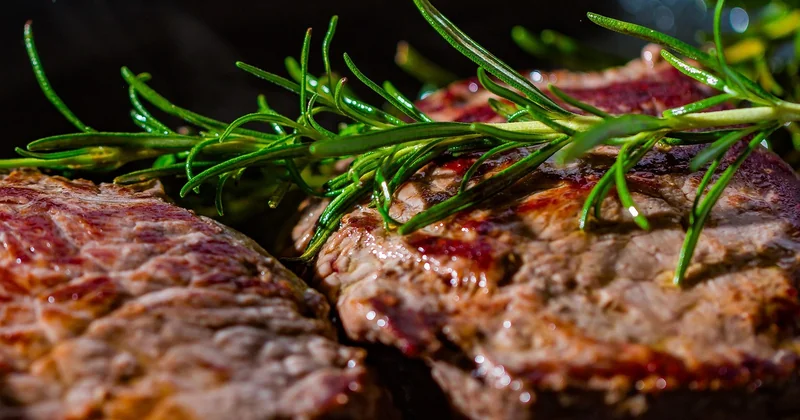
The one caveat: cast iron takes 5 to 8 minutes to reach that temperature on a normal stovetop, and another few minutes for the heat to spread evenly across the surface. Nonstick is ready in 90 seconds. If you're searing one steak, that difference is irrelevant. If you're cooking for six people on a weeknight, nonstick's speed has real value.
The cost question over ten years
Here's where nonstick quietly loses. A decent nonstick pan costs somewhere between $25 and $60. With regular use, the coating degrades — scratches, flaking, loss of release — and needs replacing in one to three years. Say you replace it every two years at $35. Over ten years, that's $175 and five pans in the trash.
A cast iron skillet at $30, properly cared for, lasts indefinitely. My oldest one is 11 years old and cooks better than the day I bought it. The seasoning only improves with use. Even accounting for a $5 bottle of oil every year and the occasional $15 for a rust rescue, the ten-year cost is roughly $80. That's less than half the nonstick route, and you're not throwing metal into a landfill every couple of years.
Induction compatibility: the factor nobody mentions
If your kitchen has an induction hob, this one decides the purchase for you. Cast iron is ferromagnetic, so it works on induction cooktops by definition. Many nonstick pans are aluminum with a coating, and aluminum doesn't respond to induction unless the base has a steel plate embedded in it. Some nonstick pans are induction-ready. Many aren't.
Check the base before you buy. If it's flat aluminum with no steel disc, it won't heat on induction. This is the single most common reason people buy a nonstick pan and discover it's useless on their stove.
A decision framework you can actually use
Stop asking which pan is better. Ask what you cook most. Run through these:
- Do you make eggs, pancakes, or delicate fish most mornings? Nonstick.
- Do you sear steak, roast chicken, or bake cornbread? Cast iron.
- Cooking on induction? Cast iron, unless the nonstick is explicitly induction-rated.
- Cooking acidic sauces often? Nonstick or stainless, to avoid iron leaching.
- Limited storage space and one pan only? Cast iron, because it does more jobs adequately even if it does eggs worse.
- You have hemochromatosis? Skip cast iron for acidic dishes.
If you can afford two pans, buy one of each. That's the setup I've landed on after years of cycling through options, and it solves the argument permanently. Cast iron handles the heat. Nonstick handles the finesse. Neither one is trying to be the other.
The thing that actually matters
The best pan is the one you'll use. I've watched people buy beautiful cast iron, let it rust because they found the maintenance annoying, and go back to a scratched nonstick pan they'd had for years. The maintenance isn't hard — dry it on the stove after washing, wipe a thin layer of oil on it, done — but it's a habit, and habits fail when they're forced.
So pick the pan that fits the cook you already are, not the cook you imagine becoming. If you love the ritual of caring for tools, cast iron will reward you for decades. If you want to cook, eat, and move on, nonstick is the honest choice, and there's no shame in replacing it every couple of years.
The argument only ends when you stop treating it as a competition and start treating it as inventory. What does your kitchen actually need? Most of us need both, and the sooner we admit that, the sooner we stop having this conversation in aisle seven.